Is a "Club" right for you? Club Amps are certainly not
right for everyone. Because they are hand crafted in the USA with only
high quality materials they are not cheap! Sorry about that. We think
our prices are very fair! Recently we've seen a lot of hand wired products listed at very low prices. If you read the fine print they are hand wired in China, not the US. I expect that a careful examination will also reveal that they use the cheapest components possible. Keep in mind that you get what you pay for.
Do you want to sound just like your favorite guitar hero? If the answer is "yes" Club Amps may not be for you. You should probably play what they play. We don't try to clone Fender or Marshall or Vox or anyone else. If you want to sound like you and not someone else a Club may be just what you need.
When you play, what does your audience hear? Our opinion (starting at the ears):
the sonic signature of your speaker or speakers
the sonic signature of your amplifier
the sonic signature of your pickups (single coil/humbucker, hot/clean)
pedals and effects
the sonic signature of you, the musician
These are the most important factors. Room or studio acoustics, and subtle things like tube choice and tube bias all come into play. If you haven't optimized the five major contributors to your sound then you won't sound your best. We can't help you with the last three items. We can help with the first two.
Our transformers, built for us by magnetics master Bud Purvine really set Club Amps a cut above virtually all other amps in the marketplace!
Paired with the right speakers for the type of music you play a Club Amp can really help you reach your audience!
So, why a Club Amp?
Quality!
Hear every note with incredible detail!
Club Amps are very quiet!
Club Amps are very pedal friendly!
One of Don's many opinions and comments: A Club Amplifier won't make you a better musician. If it could then I'd sound good. I'd like to share an analogy. It's not about guitars or amps. You may want to skip it if you find my comments boring, but there is a point. I learned to ski in the '70s. I worked really hard the first year, and could ski intermediate runs with confidence by the end of the year. Between seasons I convinced myself that if I had "the best gear" I'd be a better skier. I went out and bought myself new Olin Mark IV skis and Nordica GT boots. That's what the really hot skiers were using. What I found out was that these skis and boots were really good. Every move I made was instantly turned into a response by the skis and the boots. Did they make me a better skier? Heck no! Every time I made a tiny mistake (that my old skis and boots wouldn't even notice) my new skis and boots took it to be an instruction. I got thrown on my butt! One of the reasons a Club Amp isn't right for everyone is that it is possible that the Club Amp will respond to your every mistake thinking it's something you wanted your audience to hear. With your old amp it might get lost in the blur. YOUR AUDIENCE WILL HEAR EVERYTHING, INCLUDING MISTAKES! Understand the analogy? That said, a Club Amp can help you set a new standard for excellence in your playing.
Another one of Don's many opinions: You know the drill. Skip this paragraph if I'm boring you. Have you ever seen an ad or a product review for a guitar amp that read like, "A real tone monster, like no amp you've ever played before". Or, "I've never heard anything like the new Belchgrunge". That's just not the way it's going to work if you buy a Club Amp. We do sound like other amps you've heard or played. We think you'll notice a beautiful difference, whether you play clean or grunge. But we're honest here at Club Amps. We make amplifiers that are distinguished, but we have not reinvented the wheel. High quality components, personalized features and very careful construction and testing will give you a beautiful product that will last for decades. Compare your choice to own a Club Amp with the decision to buy a custom shop guitar from Gibson or Fender. An Epiphone Les Paul will do the same job as a "Custom Shop" Gibson and a Mexican-made "Standard" Stratocaster will do the same job as the American-made version. They're all guitars, right? And, a talented musician will make all of them sound good. The differences would be lost on some and simply not important to others, but if you're the "Club Amp" kind of musician the little things matter.
To sound best your Club Amp will probably need to have tubes changed from time to time. After a decade or two of use the electrolyte in the filter capacitors will probably be drying up. The capacitors will need to be replaced by a competent technician. That should be done with most any amp that lasts decades. But, 50 years from now your son or daughter should be able to power up your Club Amp and say to their kids, "this is the amp your granddad/mother used when he/she recorded his/her first platinum CD". They'll say "wow, that really sounds knarflink" and ask you what the heck is a CD. I guess that's already dated.
Until recently each Club Amp was built to the criteria of the musician. Until 2006 every Club was a true custom (built on a really ugly chassis, hand made by me...here you see an old chassis sitting on top of a new Series II). We've standardized the Classic Series chassis (built to extremely high standards by a local precision manufacturer) to offer many of the most requested features, so I guess you could say we are now semi-custom. But, most of our product is still build to order.
We can make 100W and 120W product, but what we do best is amps for
the studio or club. That's how we came to be called "Club
Amps". With the right speakers a small amp can sound really powerful. With a small amp you can really manage the subtle aspects of your sound, even if your style is very loud. Read on and I'll explain.
The Right Speaker!
Historically if we're building a combo for you then you would choose the speakers. At this point in time we may have installed a speaker from our inventory. While
our real business is the amplifier, we know the amp won't help you sound
your best without the right speakers.
Before I say more about speakers let me share some engineering info in almost plain English. The ear is logarithmic. Doubling power doesn't make you twice as loud. There are two ways to sound twice as loud. You can double the cone area driven by the amplifier or you can keep the same speakers and get an amp with four (4) times as much power. That's right; it takes 4 times as much power to be twice as loud if the speaker area doesn't change. If you are using a 20W amp with one 12 inch speaker you could add a second 12 inch speaker and be twice as loud. Or, you could replace the 20W amp with an 80W amp. The impedance has to be matched as you change speakers and there are other factors that make the comment above slightly inaccurate, but I hope you get the idea. More cone area means louder.
Keeping that in mind, and that I started building amps in the mid-60's it's not surprising that I like 15s; Fender Showman and Sunn Amplifiers used 15's. We've got several wicked good custom 15s from Weber and Eminence that move a ton of air from a very small cab. And, now we have the Celestion Fullback, too. My personal amp is 17W with a custom Eminence 15. There was a time when 15s were not really good for guitar except perhaps JBL D130s, but they were and still are very expensive and they tend to be too clean for modern guitar. Our 15s have really great mids and detailed highs.
Most of our combos feature a single 12. We like our 1x15 combo, but it's heavy especially the 50/60W models. We recommend the 1x12 combo with an extension cab for bigger gigs. We can offer most any Weber, Eminence or Celestion speaker, and Jensens are also an option. We stock some. Others have to be ordered while we are building the amp. We would like to use up our existing inventory, but we also want you to sound your best.















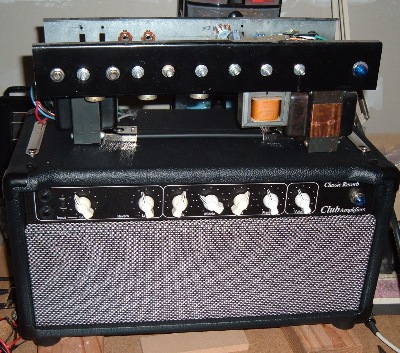 Until recently each Club Amp was built to the criteria of the musician. Until 2006 every Club was a true custom (built on a really ugly chassis, hand made by me...here you see an old chassis sitting on top of a new Series II). We've standardized the Classic Series chassis (built to extremely high standards by a local precision manufacturer) to offer many of the most requested features, so I guess you could say we are now semi-custom. But, most of our product is still build to order.
